Skip to content →

flowingmotion Posts

Mojo of Social Media White Noise

There is heaps and heaps of advice out there on how to write good blogs, mostly in the “5 easy steps” genre.  Oddly, though, there is little in the “5 dazzling blogs” or “5 perfect blogs” Digg-friendly category.  Maybe there is an adjective for blogs that I am missing!!

I don’t have any qualifications at all in literary analysis.  Indeed having a literal rather than literary turn of mind, I was a total dunce at literature at school.  What is the significance of the weather in Wuthering Heights?  It rains in Yorkshire.  You think it will stop because we want to be happy?  You get my drift.  I am bad at this sort of thing.   Zero neuro circuitry for the oblique, obscure, metaphorical and mystical.

But there is an underlying structure to blogs, good blogs, that goes deeper than “5 easy steps” and I’ve been admiring @loudmouthman’s Social Media White Noise for two weeks now. What is he doing that makes his blog so compelling?

Easy reading features of Social Media White Noise

Yes.  The blog posts are short.

Yes.   Loudmouthman is listing resources. We love resources.

Yes.   Social Media White Noise filters the social media news saving us a lot of time reading our feeds.

Yes.   The prose is readable.

Yes.   The layout is consistent and easy to scan.

All good.

Entrancing twists of Social Media White Noise

The pattern of the content is also interesting though.

Each post seems to be a brief description of mundane details in the day of two geeks in the south-east of UK, followed by a list of major events in the social media world world wide.

The mundane details are tongue-in-cheek in the self-deprecatory style of British humour.  The contrast between the mundane details and world events also seems to be the key to much British humour.  There is a sort of smugness, we are above it all, the world is really ridiculous anyway, ironical view which is commonplace in our descriptions of our world.  We try and try but nothing works but it doesn’t matter anyway. Humour that is incomprehensible to many cultures and faintly irritating to others.

I think the blog really works though because of the sense of two streams of time – the forceful main current of social media world wide and the choppy waves and eddies lapping at its edge.

But it is the the juxtaposition that seems important.  If the content were reversed and we saw the main events of the world in the background and our own daily activities in the foreground, it wouldn’t work.  It needs the tension of foreground and background interchanged.

But why are the streams important?

I rather suspect the sense of motion is appealing to me – I am not sure whether it is to others.  I would be interested.

What is even more important, I think, is the sense of belonging to something larger than ourselves.  When we see the backdrop of our work,  the mundane realities, and even brutalities, of our daily lives take on perspective, if not meaning.

It is the counterpoising of day-to-day life against the broader picture that conveys the sense of authority and feeling that these are people we look to for leadershp.

To convey a picture of where we are going – our sense of purpose and even the comedy of our own confusions – against a picture of where are world is going, orients us and provides a valuable service.

Now to figure that out for my own blog.

My recommendation

Social Media White Noise is very clever and worth a read.   So head on over and grab the feed.  You will be happy.

And if you weren’t a dunce at literature, tell me what they are doing to make it work so well.

Enhanced by Zemanta
One Comment

You really must be in a positive mood to get the job of your dreams

Downtown Core, Singapore's business centre.
Image via Wikipedia

I am ever so grateful to Daryl Tay who blogged his successful search for a social media job in Singapore.

Now Singapore is a prosperous place.  Daryl has a good degree.   And he is an adventurous outgoing guy who instigated Social Media Breakfast while he was an under-grad.

But Social Media is new industry and Social Media firms aren’t queuing up at University Career Days looking for bright-eyed bushy-tailed students to gopher for them on a two-year graduate program.

So Daryl had to make his own job and I think the contrast between his positive attitude and the unfamiliarity of his task really put into perspective my job as a career coach, and indeed, what you must demand of your career coach.

What you want from your career coach

Your career coach’s job is to get you into a positive frame of mind.

If you are feeling bruised and sore, you cannot think even think straight. You certainly cannot be sufficiently creative to find the job of your dreams in the hurly-burly and confusion in the marketplace.

What Daryl brought home to me, is that it is not good enough for me to tell you the theory. You probably know the theory at least intuitively.

I must get you into a good mood so you can search creatively.

Read on to see if I am on the right track

Mid 2009, Singapore

Daryl Tay, social media evangelist blogged his job search that led to Blue Interactive in Singapore.  Success!  A good agency, new challenges, freedom to blog!  The perfect first job for a newly-minted graduate.

Daryl puts his success down to the generosity of the social media world.  It is a generous world for the most part.  He passed on information about a job to an acquaintance, who reciprocated in due course, without being asked.  He followed up her lead, which led in turn, not to a job, but to ten more “names”.  He followed those up, and got 3-4 interviews, one of which was with Blue.

That’s pretty good by all accounts. I saw figures somewhere that in the US you should budget for 3-4 “qualified leads” from 100 approaches.  So Daryl did 10x better than average.   A 1000% gain!  Worth paying attention to.

What led to Daryl’s success?

  1. The generous ethos of the social media world.
  2. Singapore is relatively prosperous.
  3. Singaporeans are unusually punctilious in their business dealings. They don’t waste each others time.
  4. Daryl is well known in social media circles as he is an established blogger and hosts Singapore’s Social Media Breakast.
  5. Daryl took a degree in marketing including a semester in Canada.
  6. Daryl is a nice guy.

Yes, all these are true. What is also true is that Daryl did not mind having to make his own job. Nor was he offended by the people who did not respond to his approach. Nor did he seem particularly bothered by interviews that did not lead to jobs.

Has Daryl got a thick skin? I don’t think so. He has always seemed like a sensitive, responsive person to me.

The point is he was in positive frame of mind. So, his mind went automatically to two thoughts:

  1. What could he create?
  2. What worked well and what should he do more of?

Such simple questions but try thinking that way when you are in a negative mood! It is really hard!

Working with a career coach

By the time people come to see me as a work & organizational psychologist, otherwise known as a career coach, they are pretty fed up. The job market is not what they thought and they want me to make it responsive. They want me just to make the bad stuff go away!

The general pattern of career coaching is based on career guidance of old. It has changed a little, but not enough.

We typically go through four steps.

  1. With tests or other means, we figure out who you are.
  2. We match you to opportunities in the world.
  3. We prepare you for interviews.
  4. We celebrate or commiserate with the results.

Straightforward – yes, but wrong.

Positive career coaching

While you are in a bad mood, you see all the problems.  It is nothing to do with being optimistic or pessimistic.  It is a natural reaction and the recalcitrance of the world is very real to you at that point.   So our job is to get you back into a good mood.  Then you will do the rest yourself!

  1. We have to get you thinking about what you do well (most services do that, but it is not enough)
  2. We have to get you exploring the work world and identifying 10 companies whom you think are interesting.
  3. You need to know enough about these companies to approach them.
  4. You need to approach them (preferably working down the list from 6 to 10 so you can make your mistakes on the second half of the list).
  5. It helps to keep your coach on sides to discuss the results. You will decipher the feedback quicker and they’ll help you soak up any disappointment.
  6. Go after your top 5 companies with gusto!

That’s pretty much what Daryl did, but without the recovery from a bad mood at the beginning.

Does positive career coaching work?

I’ve often tried to get people to list these 10 jobs and predictably, they do it when they are in a good mood and they won’t do it when they are in a bad mood.

In a bad mood, they just want to pick up the paper, or go on the internet, and see a list of suitable jobs.

Your coach’s job, my job, is to get you back into a sufficiently positive frame of mind so that you list those 10 companies and work out what you can do with them.

After that you will approach them with a spring in your step, laughter in your voice, and mental agility that will delight even you!

It is not easy.   After all that is what you pay us for.   To get you back into a positive frame of mind.   When you are focusing again on what does work, it all clicks together and suddenly everything happens for you.

This is not positive thinking or wishful thinking, I might add. It is painstaking work listing and acting on what works until the world seems to be full of opportunity again.

To Daryl

So well done Daryl, and thanks.  I knew all this but reading your story brought home to me that it is not career coaching that is important.

It is focusing our minds on what works, regaining the positive mood, and sticking with you during the search to keep you positive.

Your success brought that home to me.  Well done!  A lot of people will take heart from your initiative.

To everyone else

Make sure your coach delivers. It is their job to put up with your bad mood until your recover your sense of humour!

Pay them well and buy them a good meal when you get the job of your dreams.  You’ll be good company by then. 🙂

Enhanced by Zemanta
3 Comments

5 agreed points about happy prosperous work in the new economy

Mavens of work

FOUR loose communities of internet pundits are watching changes in work with great interest –

1 Professors and academics

2 Management consultants who specialize in organizational design

3 Social media gurus who explain developments

4 Marketers and purveyors of social media services who hope to stimulate demand

A FIFTH group, poets, might have a look from time to time but they probably find our prose dull.

What are we all looking for?

  • We know that the world economy is on a cusp. The industries of the 20th century have reached a point of diminishing returns. And we are definitely moving toward a future of new industries underpinned by advances in biotechnology and other sciences.
  • At the same time, we are communicating across countries and industries at the cracking pace made possible by the internet. Work has become quite different. And so has the leadership of organizations.

What are we pretty certain about?

I am yet to get my head around exactly which industries will boom. It is also not clear which activities will need formal organizations and which we will pursue as-and-when using social media tools like Facebook.

What is clear are the psychological “rules” of our new age.

The 5 points of appreciative inquiry originally described by David Cooperrider of Case Western seem to be repeated over and over again in different words with different examples.

As a case in point, a Thai blog quoted an Education Professor at Harvard who identified 5 competencies for the modern age.

What are the core competencies needed in this century? Harvard Graduate School of Education professor Helen Haste has identified five that we should begin teaching our students. We business managers should also consider how to bring these skills to our companies and careers.

Managing Ambiguity. “Managing ambiguity is that tension between rushing to the clear, the concrete, and managing this ambiguous fuzzy area in the middle. And managing ambiguity is something we have to teach. Because we have to counter the story of a single linear solution.”

Agency and Responsibility. “We have to be able to take responsibility and know what that means. Being an effective agent means being able to approach one’s environment, social or physical, with a confidence that one actually will be able to deal with it.”

Finding and Sustaining Community. “Managing community is partly about that multitasking of connecting and interacting. It’s also, of course, about maintaining community, about maintaining links with people, making sure you do remember your best friend’s birthday, that you don’t forget that your grandmother is by herself this weekend, and of course recognizing also that one is part of a larger community, not just one’s own private little world.”

Managing Emotion. “Really it’s about getting away from the idea that emotion and reason are separate… Teaching young people to manage reason and emotion and not to flip to one or the other is an important part of our education process.”

Managing Technological Change. “When we have a new tool, we first use it for what we are already doing, just doing it a bit better. But gradually, the new tool changes the way we do things. It changes our social practices.”

To make my point, how do these well phrased principles relate to the principles of appreciative inquiry?

The positive principle. Instead of assuming we now the solution and finding a plan to fit, begin with where you are now. Take the first step and see what you learn. (Managing Technological Change.) This is also know as rapid prototyping or Ready Fire Aim.

The social constructionist principle. There is no one view of the world which accounts for all our realities. We need to listen to all our points of view and look for the common linkages between us. These are ever changing as our experiences of the world change. (Finding and sustaining community.) Diversity and belonging are key to modern enterprises. If we neglect either, we rip the guts out of our organizations.

The anticipatory principle. We are doers by nature and like nothing better than chasing after a goal. To achieve a goal, we need to understand how things work, and pay attention to the results we achieve. Feedback, though, comes back to us from all angles and to disentangle what we are hearing, we have to learn about the world and our place in it. Our love of Agency and Responsibility is never clearer than in computer games were we pursue quests and test out our competence with others in competition with “forces of nature” and competing interests. We are being chided to take responsibility. We do so naturally. The trick is to figure out what is under our control.

The simultaneity principle. The world exists only in so far as we pay attention to it. This is not an abstract philosophical point. It is also a point in physics. It doesn’t mean we can ignore what we choose or make things up. It means things change their meaning and their essence when we notice them. And we change when we notice ourselves. David Cooperrider put the principle like this. We move in the direction of the questions we ask. To put this concretely, I don’t go to London. When I start asking where is London, I start moving toward London. If I ask the question a different way, how do I drive to London, I will probably do something different, such as not use the train. (Managing Ambiguity).

The poetic principle. The poetic principle is not poetic! But “the good, the true, the better and the possible” is. Most of us had poetic language beaten out of us at school and college Dry, wooden language became a mark legitimacy and is popular with the powerful because it conceals their motives. When we are firmly in charge, we reject the emotions and motivations of our audiences so we don’t have to acknowledge their interests. By using dry language, we can claim that our interests are truths – so convenient! Poetic language engages the interests of others. It is emotional. It is not deliberately emotional. It is explicitly emotion. And we use emotional language to find the common basis of our separate and sometimes conflicting interests. To say emotional language is honest negotiation sounds unpoetic – but that is what it is. Many people in power, including teachers, are disconcerted by the demands of Gen Y to approach issues from their point of view. How can this be organized, they cry? Well I have taught a 850 person class of Gen Y. They do evaluate every lecture with the question : what does this material do for me, right here, right now? They behave like 850 demanding CEO’s. Once we’ve got over our surprise, it works. Stand and deliver! We look at the emotion – their point of view – and the range of their points of view – and deliver the material accordingly. They learn more. They learn the substance. They learn what to do with the content we are teaching. They learn about the range of perspectives in the class. They apply the material. Isn’t that what we are asking for – engagement? To engage we have to come from their point of view – not ours which we concealed in pompous language.

We seem to be on a plateau of understanding

It strikes me that professors, consultants, gurus, geeks and poets have come up different sides of a hill and found themselves on flat piece of ground. We seem to concur, for now, on the essential ingredients of “new work”.

I’m sure these principles will be refined in due course. And it is good for each of us to rephrase them in our own words using our own examples. It helps us understand their nuances and limitations.

They are clear enough for now, and they appear in sufficient sources, though, to teach.

They are also clear enough to try out in practical projects.

The next goal

From now onwards, I am only going to scan theoretical pieces to see if they are saying anything new.

Otherwise, I am looking for examples of collective action and how the principles worked in practice.

I think I am interested in active experimentationhow we learn about these principles, deliberately or accidently.

If you have an example, do let me know.

Leave a Comment

My virtual knight in shining armour – from panic to productivity in less than 1 hour!

A long time ago when I drove a VW, I got some sound advice.  Always have a tool kit in your car.  Otherwise how else will the shining knight in a Red Ferrari fix my car when he stops to help?

And now I live half my day in a virtual world, I must make sure shining knights on Cross Loop can find me – so they can rescue me from the dragons of my own mis-steps and panic!

And so should you!

Today, Loudmouthman, speedy, nippy geek from Horsham rescued me in minutes, and I live 4 hours drive away.

This is how he did it, and this is what you need to know, because one day you are going to need Nik and you are going to feel so much better knowing he is just over the horizon!

It all began last night

. . . as I tidied up my computer,  I created a new user just to check what standard settings looked like.    All seemed in order.   There were two users, both Administrators, and I was logging in and out of both quite happily.

Disaster!

This morning, I could only log in to the dummy.

Panic!

Send up the distress rockets!

I logged in to the dummy account, got onto Twitter, and fired off a May Day call to no one in particular.

Whew!

@Loudmouthman answered and told me to download Cross Loop and to contact him.

Minutes later, Nik was connected. He took over my machine though Cross Loop, and though other services offer this feature too, most importantly, I could also

  • Send a message to him including my landline number, so he could call me, which he did.
  • See the ratings of his many happy customers.
  • Look at his competitors should I wish to.
  • See his hourly rate.
  • Get a quote.
  • And pay him by Paypal.

My predicament explained

By setting up a second user with admin rights, I was no longer given the option to login in to plain old “Admininstrator”

Client Education

Working remotely, Loudmouthman showed that the Administrator account was still there (C: Drive and Documents & Setttings).

Panic subsided!

Diagnosis

Still working remotely, Nik checked my description of the problem by having me log off to show him that Administrator really couldn’t be accessed from the Login screen (which of course he could see remotely).

Solution

I could hear him looking something up in the background (his keyboard was going noisely).

Then he had me log in again to the dummy account and he went into some Windows Settings and added a line to activate Administrator.

Hey presto, we were done. And it would have been faster if I hadn’t been in a panic.

Final Check & Wrap-Up

I logged out of the dummy account and back into Administrator – and downloaded Cross Loop again which was no longer visible.

I had to make another request for service. Then I asked for an Estimate, accepted it, and then asked for a Final Bill.

A PayPal screen came up and I paid promptly and printed out the receipt for the accountants.

Just the way I like it.

Done, dusted with all the paper work wrapped up.

How to get hold of Loudmouthman?

On Cross Loop as Loudmouthman

On Twitter as @loudmouthman

Through his website, Loudmouthman

On Skype thebutlershouse (Nik Butler)

And to find out what is causing ripples in the Social Media world in the south-east of UK on any one day, Nik’s blog Social Media White Noise is well worth a visit.

Thanks Nik! From panic to productivity in under an hour!

Enhanced by Zemanta
2 Comments

3 jawdropping facts about Linkedin members in UK

I’m a member of LinkedIn, the professional networking site. You probably are too. If you live in the UK, you are one of 1.8m members. Around 30m people in the UK are of working age. So about 6% of us are LinkedIn members.

So, is it worth belonging to LinkedIn? And if you are, who are you likely to meet there?

I painstakingly took some numbers off Google Adplanner and I have three surprises that will make you rethink Linkedin membership.

When you’ve whizzed through the headlines, narrative and graphs, tell me what you make of this picture.

#1 College graduates in UK do not dominate Linkedin

That’s a surprise isn’t it?

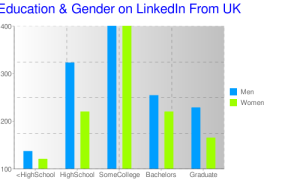
Check the graph. Linkedin in the UK is dominated by people in the range of “some post-school education but less than a degree”.

Education & Gender on Linkedin from UK (drawn in Chartle)

Should we be surprised?

About 25% of people in UK have a degree. 33% of male Linkedin members in the UK finished University. Slightly fewer than 30% of female members of Linkedin in UK have degrees or graduate degrees.

So the facts go in the right direction.  Graduates are more likely to join Linkedin than people with other levels of education, but, because three-quarters of the population have not been to university, even members who have no further education at all outnumber those with a first degree.

This is a salutary lesson for us all. Even on Linkedin, the real world dominates. And in the real world, most people do not go to University.

#2 People who earn 50K pounds a year (or more) dominate Linkedin

I will surprise you again.

In the next two graphs, we see that people whose household income exceeds 50K a year dominate LinkedIn.

Salaries of Men on Linkedin UK (drawn in Chartle)

OK, this is not so surprising in itself. After all, Linkedin is a high-end service. Google also reports household income. Average income in the UK is about 20K per person and if two people work, 50K is an average amount. So we shouldn’t be surprised to have Linkedin users from households who earn 50K a year.

(BTW, a 50K salary puts a person in the top 10% of the UK.)

But given that Linkedin is dominated by ordinary people – may be this figure is surprising?

When we look more closely at the graphs, we see that education makes it easier to earn household incomes of 50K+, but there are lots of people out there with ordinary education levels who also have household incomes of 50K+.

To spell this out:

  • If you are a male Linkedin member, with a graduate degree, you probably earn 50K+.
  • This is also true if you have a Bachelor’s degree – but about a third of ordinary degree-holders on Linkedin earn in the 30K to 50K range.
  • If you are in the dominant group, “the post-school but no degree” crowd, you are more likely to be in the 30K-50K range but, there are as many people in this group earning 50K+ as there are degree holders earning 50K+ ! There are also more of this group earning 50K than graduates earning 50K+ – largely, I suppose, because there are fewer people with graduate degrees in the market.  “The post-school but no degree” crowd rule, OK?  Fonzi, still rules!

Burn this on to your brain.  If you find someone with high household income on Linkedin, they could come from almost any education level.

We have two apparently conflicting facts.

  • Education helps us earn money!
  • But earning money telling us little about a person’s education!  There are just as many high earners from lesser education levels (at least on Linkedin).

The pattern for women on LinkedIn is similar. But, it is confused by the over-powering dominance of women in the “more than high school but no degree group”.  They rule even more than they do among men.

Salaries of Women on Linkedin UK (drawn in Chartle)

#3 The high earners in Linkedin are young and the younger members of Linkedin are high earners!

This is the really stunning surprise!

See at the next graph.

The 25-34 year old group have high incomes AND they outnumber older people with high household incomes!

Have a good look at that graph and burn it onto your memory –

Who are the big earners on Linkedin UK? (drawn with Chartle)

Now to the interpretation.

It is not a surprise – though nor is it acceptable – that women earn less than men. We should also disentangle the more complicated picture at the the mid-age levels. But we all knew this already.

More importantly, where are the older high earners? Why don’t they join Linkedin? Are they that complacent, or are they outnumbered by young people in real world too?

I did check with the UK Government Statistics Office. And I spoke to a professional statistician. They don’t have numbers going from high salaries to age. They have a 1% sample of taxpayers and they present data from age to salaries in percentiles. Their reports suggest – as common sense suggests – that the workforce is dominated by people in the 40-49 range who also have higher salaries.

So what is happening here?

Because we haven’t any baseline data for the UK working population, we have to work with some sweeping generalizations – never a good idea.

It looks as if Linkedin is attracting younger people who are high earners.

Remember these things.

  • 29% of men on Linkedin in UK who have household salaries of 50K+ are aged 25-34
  • 35% of women on Linkedin in UK who have household salaries of 50K+ are aged 25-34
  • 57% of men on Linkedin in UK who have household salaries of 50K+ are aged 25-44
  • 68% of women on Linkedin in UK have household salaries of 50K+ are aged 25-44

Interpretations?

Possibly, because women tend to partner men who earn more than them? Worth exploring, I think.

So what eureka moments did I have in this time-consuming micro-analysis of Google AdPlanner?

  • The typical member of Linkedin in UK does not have a degree (700K out of 1,8M)
  • The typical household income bracket of UK Linkedin members is 50K+ pounds.  University education makes it more likely you will be in the high earning group but people who finished university are outnumbered by people who didn’t or didn’t go at all.
  • The high earning bracket is dominated by 25-35 year olds!

How will I use this in practice?

  • I am going to find out who are the young (25-34 and 35-44) women on LinkedIn with household incomes of 50k+.
  • I know that less than half will have a degree but I can fine-tune this information AND find out what they do.

What will you do with it?

5 Comments

3 Quick Steps for a Big Mac Index of Website Keywords using Google AdPlanner and Google Adwords

I find Google statistics a little bit like the Zimbabwean currency. It doesn’t take long before I am confused by the zeros.

In short, I need a Big Mac Index to give me a sense of  what is a lot, or a little, of internet traffic.

My Big Mac of Internet traffic in UK in July 2009

Big Mac of Keywords
Big Mac of Keywords

You see here that about 3.5K optimistic users searched for “barbecue” in July 2009 – about 0.01% of UK’s 40M internet users.

About 7K searched for “summer” and “psychology” respectively – each accounting for about 0.02% of internet users (2 in 10 000).

Cricket against Australia this summer (the Ashes) has been exciting and 40K, or 1 out of 1000       of us turned to the internet for information. That is 0.1% of UK internet users.

But compare that to 400K searches for the “weather” (1 in 100 of us or 1%). And to 112K of us who searched for “jobs”. That is 1 in 360 of us or 0.3% of UK internet users.

About half of the “Unique Visitors” searching for “jobs” accessed the government website, BTW.

Google AdPlanner vs Google Keywords Tool

I found all the figures on Google AdPlanner by setting Geographical Location to UK and putting in the Keywords into Keywords Searched.

What is the difference between Google AdPlanner and Google Keyword Tools?

The number of people searching for “jobs” with Google Adwords – with “narrow match” and location as UK – was just under 3 000 000 searches in June. The slight mismatch of dates doesn’t really matter for our current purposes. That averages about 30 searches a month for each UV (unique visitor as calculated by Google AdPlanner), or 1 search for each day of the month.

The “broad match” for “jobs” was much higher at 124M.  To keep it to round figures, that is about 1000 searches for each UV, unique visitor, or about 3 a day, or 5 searches per person per business day.

So that is my Big Mac for Keywords!

1. Choose five marker words to put into Google AdPlanner with geographical location set at UK.

2.   Calculate Unique Views or users for each Keyword by picking a website (any one) and dividing the UV by the % reach and multiplying by 100.

3.  Then double check against Google Adwords, using UK and both “broad match” and “narrow match”, to get a sense of the intensity of search by each unique user.

Comments?

Enhanced by Zemanta
Leave a Comment

17 facts about Twitter and Facebook graph in UK for your PEST analysis

Facebook is “who knows who” in London?

If you want to find someone in the UK, go to Facebook.  1/3 of the country is there and more than 1/2 of our internet users are there.   3/4 of Londoners are there.

Because so many Londoners are on Facebook, it is also London party.  Just over a quarter people in the UK live in or close to London, but nearly half of Facebook members are Londoners

Almost everyone who uses Twitter is on Facebook.  Its easier to say that 1 out of 7 Twitter users do not use Facebook.

But as 6 out of 7 of their Twitter friends will be on Facebook, they are well connected!

The question is whether you can find the other 2/3 of UK residents through your Facebook network.  It would be work a try, wouldn’t it?  Can you find and meet anyone of the 61 million people beginning with your Facebook network?

The picture

Twitter & Facebook Users in UK
Twitter & Facebook Users in Users

The numbers

I made the diagram using the online chart maker, Chartle, using the numbers below, some of which I got from Google Adplanner on 2 August 2009 and some of which I got from Wolfram Alpha.

1.  People in the UK : 60.8 million
2.  Internet users in UK : 40 million (66%) (2006 – probably higher now)
3.  People in the work force before the credit crunch:  29 million (almost 50%)
4.  Young people 13-16, 16-18 and 18-24 who are not in the workforce but who are active internet users: Unknown (do you know?)
5.  Retired people who are not in the workforce but who are active internet users : Unknown (do you know?)
6.  People in the London : 7 million  (about 13.5% of  UK residents)
7.  People in the wider London metropolitan area : 13 million (about 27% of UK residents)
8.  People who use Facebook in UK : 22 million ( about 35% of UK residents and 55% of UK internet users)
9.  People who use Facebook in the wider London metropolitan area: 10 million (77% of residents, 25% of UK internet users, 17% of UK residents, 45% of Facebook users)
10.  People who use Twitter in UK: 3.5 million (6% of UK residents and 8% of UK internet users)
11.  People who use Twitter and Facebook in UK: 2.9 million (7 % of UK internet users, 13% of Facebook users and 83% of Twitter users)
12.  People who use Twitter and not Facebook in UK:  0.6 million (17% of Twitter users and 1.5% of UK internet users)
13.  People who use Twitter in the wider London metropolitan area:  1.8 million (18% of London internet users)
14.  People who use Twitter and Facebook in the wider London metropolitan area : 1.5 million (15% of London Facebook users)
15.  People who use Twitter and not Facebook in the London metropolitan area : 0.3 million (3% of London internet users)
16.  People from outside London who use Twitter and Facebook: 1.4 million (12% of Facebook users)
17.  People from outside London who use Twitter and not Facebook: 0.3 million (difficult to know the percentages)
5 Comments

The productivity of procrastination. Yes!

In the good company of entrepreneurs

Are you one of the 14% of UK’s working population who works for yourself.  I am!

And if you are, like me and so many others in UK and everywhere where solopreneurs and the Free Agent Nation are booming, you are probably obsessed with productivity and getting things done.

You also probably beat yourself up for procrastinating. And you feel really bad on days when you just cannot get yourself going?

Is that you? Well, you are in good company. We all feel the same way.

To stay sane, this is what you need to know about procrastination and productivity

1 Keep your to do list simple

2 Accept that some days you need to chill out

3 And for the surprise – procrastination may be a sign of experience

I am not going to write on keeping your to do list simple. Lot’s of people have done that. I also won’t write on chilling out. I’ll do that another day.

Let me stick to the surprise that procrastination is wise

. . . and remind you about Caesar as he sat with his army on the wrong side of the River Rubicon. He knew that once he crossed the Rubicon, he would be declaring war on the city of Rome. And battle would commence.

You are like Caesar waiting to invade Rome

Some times, when we are resisting getting down to work, we are in the same position as Caesar on the edge of the Rubi con. We know that once we cross, there is no going back. We will be causing less strife, but once we get started, we will accomplish this task no matter what.

As Caesar undertook a long march and bloody battles before he triumphed, so will we. We know we face long hours, physical fatigue, frustrations, disappointments, conflict and anger.

We know about the power of goals. Once we get going, we move inexorably toward them. We don’t get care what gets in our path. We trample over it all in our determination to win our prize.

With age comes wisdom

When we are twenty-something, we are very good at crossing the Rubicon because at that fresh age, we don’t really understand the damage we do as we stampede everyone in our way.

When we are older, we resist.  We know that the victory is not always worth the battle.  We know we emerge the other side as a different person. And there is no going back.   At the very least, we want to linger and enjoy the desultory delights of just being with people before battle commences and carnage ensues.

But we do get moving eventually

But we do get moving when battle calls.  We know, rather sadly, that we enjoy the battle even though it has consequences.   We will even make new friends, because undoubtedly once we set forth with a clear mission, the universe does conspire to help us.

Get you things. Dreams mean work.

So we dilly-dally for a while. Half-treasuring the present. Half-summoning up the psychological resources. Is that so unwise?

We will be leaving soon and we must say good-bye properly so we can so hello to a new dawn.

Enhanced by Zemanta
2 Comments

5 pretty petals of future work

I can see clearly now

Today, I visited Wirerarchy, Jon Husband’s blog. I was delighted to find the 5 principles of future work in plain language.

I do encourage you to go over and read his version.

To make sure I fully understood what Jon was saying, I rewrote his five points in my own words and compared them to other writings on the future of work.

Yes, Jon’s principles almost perfectly match the work on positive organizational scholarship, poetry and work, Hero’s Journey and positive organizational design.   Jon uses much more accessible language though.

Here is my version. I’ll add links to other versions below. And then I’ll walk the talk and tell you how I used the principles in the most unlikeliest of circumstances!

1 Changing focus

The future of work is not about institutions and organizations.

The future of work is about you and me.

2 Listening to the people who do the work

We don’t want to talk about abstract theories any more.

We want to hear the stories of people. Directly. With no translation.

3 Valuing what we can do for ourselves

We don’t want organizations and institutions to decide things for us.

We ‘ll support changes that allow us to do things for ourselves.

4 Representing ourselves

We won’t listen to so-called experts who secretly represent other people.

We’ll listen to people we know or who our friends recommend.

5 Being active and positive

We aren’t interested in being told to wait.

We will begin with what we do well. Right here. Right now.


How would you phrase these rules-of-thumb?

I would love to hear what you think of these rules-of-thumb and the way I have phrased them.

Links to my previous posts and slideshare

All phrased a lot more esoterically –

Previous posts on future work

The essence of a happy life is a point of view

5 point comparison of the Hero’s Journey, Appreciative Inquiry and Positive Psychology

5 poetic steps for exiting a Catch 22

Lighten your personal burden for navigating 2009

Be still: Kafka and Joseph Campbell

Slideshare on future work

Positive organizational design

Positive organizational scholarship

So how will we get things done in this enchanting, new world?

For three years, I taught Management to a very large class of 800 to 900 students in a lecture theatre with 400 seats. You may remember attending lectures in one of these oversized rooms yourself. Hordes of students come in and sit in rows and struggle to stay awake as the lecturer drones on.

Of course, no lecturer wakes up in the morning intent on being deadly dull. But they do feel constrained. After all, how much can you do with this format and the size of the class?

Well, a surprising amount – if you follow the principles above.

The world through the eyes of the individual

I was teaching Management and Organizations. Students simply aren’t interested in perspective of the organization. But if you can think of how they view the organization from the vantage point of their part-time jobs and where their careers are going, then you have their attention.

Give me the whole story at once – circumstances, goal, steps, feedback loops, quirks and fancies

Students aren’t interested in the rules of organizing. No matter how elegant these rules are or how much work we put into thinking them up and trying them out!. They do like case studies, though, where they could follow a story. Then their active intellects take over. They imagine themselves playing a similar role in similar circumstances and start asking probing questions.

Don’t leave me out of the story – let me try out parts of it

Students don’t like being passive. Taking notes is better than sitting still. Solving puzzles is even better. I used questionnaires a lot in which they could see illustrations of concepts and relate them to themselves. Or I used two sets of power point slides – theirs had blank spaces and mine had the answers. In this way, they could anticipate (not just fill in) what I was going to say.

The way I relate to other people is part of the story – I’ll do this with others

Learning is social and students are influenced more by their peers than by us. They like to see and hear what other students think. There is a surprising amount of feedback from the noise and murmuring in a lecture room which is why so many students come to class in the first place! We also took polls often with a show of hands. It is active in an minor way. More importantly, students could see how much opinions varied. Developing a keen acumen of how much we vary in our preferences will be important to them as organizational leaders and influential citizens.

Harvard has a video of 2009 Reith lecturer, Michael Sandel, using the Socratic method with 800 students in one lecture theatre. Our students would have liked that – as long as we were able to be as courteous as Professor Sandel. Students really don’t like being put in the wrong in front of their friends, particularly in such a large room. (Who does?)

There is no journey unless I can take the first step

The jobs my students imagined after graduation were, to my surprise, not particularly ambitious. Though I didn’t fully approve at the time, now I think they had a well developed sense of starting with the ‘ground beneath their feet’ and growing from there.

These students particularly liked techniques that helped them do their jobs better, right now, or helped them put in words something that had puzzled them for some time.

Am I exaggerating the good points and dismissing the weak points?

You might be thinking that this was a University – we set the curriculum and the exams and the students did not have much control.

It is true that we began each year with a ‘classical’ textbook. But we would take topics that students had responded to well and use those as cornerstones to introduce new topics -or extend the conversation, so to speak. Thus as the year proceeded, a theme would emerge that was distinctive for that class.

One year, for example, the refrain became: “I will be me as I am. Not who you want me to be”.

You might recognize this line as coming from the film about Steve Biko, Cry Freedom.

Organizing for  “Me as I am.  Not who you want me to be.”

The challenge of management, as we put it to that class, is to design organizations where each of us can be “Me as I am. Not who you want me to be.”

What do you think?

Can you imagine organizing along these lines? Would you like to give me a case and see if I can rephrase it using Jon’s five principles?

Enhanced by Zemanta
Leave a Comment

Beating the odds in recruitment and selection

338187446_682b87504a_mOne of the biggest complaints we hear from businesses is that they cannot hire the skills they want in the UK market.  It’s called the talent war.

I want to show you a simple calculation I did for someone that might explain what is giving you a headache in your recruitment and selection.

Person specification

This little firm was looking for ‘partners’ to work in a role similar to agents or franchisees.  Their partners don’t have to have any particular qualification, so they should be easy to recruit.  After a little thinking and talking, this is what we came up with.

  • The partners don’t have to be super-bright,  just normal bright and have finished high school .
  • The partners should be energetic & persistent and are likely to have demonstrated this energy by excelling in competitive sport, the arts, or some activity that has required them to make a clearly great effort than their peers.
  • The partners should be entrepreneurial.  They should have a history of trying things out and be just as happy when things don’t work out.  They are curious.
  • The partners need to be honest.  I don’t mean financially meticulous – I mean wanting to deliver a good service.  They are likely to have done something well in the past even when people around them wanted to take shortcuts.

Running the numbers

Now we can add some figures to this model and here is where you might get a surprise.

Let me remind you of some figures.

  • The midpoint on any characteristic divides the world 50:50.
  • The next step up divides the world 83:17.
  • And then next level up divides the world 97:3.

These splits correspond to 3 standard deviations on the right hand side of a normal curve.  You might recall that?  We could use finer divides but we will start with these to get a preliminary fix on where we are going.

Intelligence

The people we are looking for do not have to be super intelligent.  University and above is at the 83:17 divide.  We are happy at the 50:50 divide.  Below that, people may have trouble filling in commercial documents.

Energy & persistence

We are looking for someone who stood out in some way – played at the highest levels of school sport, for example, or raised a lot of money for charity, or even did well at academics.  Probably at the 97:3 split.  Someone who took a big prize at school.

Curiosity

These people don’t wait for someone to tell them what to do.  They work things out and find new opportunties.  They aren’t people for the sausage-machine of institutions. They are the people who make us think, “I wish I had done that”, or “How did you think of that?”  And they view setbacks as adventures.  97:3

Honesty

Unusual levels of integrity and sincerity.  At least once in their lives, they’ve done something properly when people around them were spinning, skiving or taking shortcuts.  97:3

How many people in the UK fit this description?

There are 30 million people in UK of working age.  How many of them fit this description and are candidates for our recruitment and selection drive?

Half of them have the intelligence required: 15 million

3% of the top half of intelligent people are very energetic and persistent : 450 000

3% of these have unusual levels of entrepreneurial spirit or curiosity:  13 500

3% of these have the commitment to integrity that we need: 405

(and this is from aged 16 to 65 – 405 people in the UK match our specification).

And how many of the right people are looking for a job?

Well, first of all let’s look at turnover.  It is usually 14% a year in the UK and that includes the high churn sectors like hospitality and catering.  Even if we bump up the turnover rate arbitrarily to 20% for the recession, we have only (.2 x 400) =80 people in our group who are looking for a job.

And of course some of these are doctors and lawyers, and some people are in the wrong sectors or wrong part of UK.  They are not available to be recruited or selected by us.

Not many left are there?

Shocking isn’t it?

I am used to the process of selection and to these numbers, yet they still shock me.  So please find my error and dm me.  I am hoping you will find my mistake because the numbers are shocking.

My point – and it is a serious point –  is that you cannot have one demanding requirement after another.

There simply aren’t enough people in the UK to meet your demanding needs.

There aren’t enough exceptional people in the economy to run it if is based on exceptional talent.

Our businesses need to run with normal people.

  • When we are selecting, it’s best to set the minimum requirements of the job, preferably from the candidate’s point of view, and begin there. Trim your list.  Ask, “Is this feature absolutely required,  and if so why?”
  • Stop adding requirement after requirement!  No more than three requirements!
  • After that, be ruthless in thinking about this recruitment assignment from the candidate’s point of view.

Ruthless in thinking about selection from the candidate’s point-of-view.

No one taught you that at uni, did they?  Yep, we like to keep some secrets to ourselves.

But now, it’s yours.

Review your HR specifications.  And keep it real.  Let your competitors be the ones to live in the world of make-believe.

Leave a Comment